Lahore is a city that does not simply preserve history—it lives with it.
Few cities in Pakistan offer such a remarkable concentration of architecture, culture, food, literature, and living traditions. For centuries, Lahore has stood at the crossroads of South Asian civilizations, serving as an important center under successive Muslim dynasties, reaching extraordinary architectural heights during the Mughal period, developing a distinctive Sikh heritage, and later becoming an important center of British colonial administration.
Today, Lahore is Pakistan’s cultural capital and one of the country’s most rewarding destinations for international travelers.
The city is famous for the monumental Lahore Fort and Badshahi Mosque, the intricate Wazir Khan Mosque, the tranquil Shalimar Gardens and the historic streets of the Walled City. But Lahore’s character cannot be understood through monuments alone.
Its real attraction lies in the atmosphere between them.
Walk through the narrow lanes of the Walled City and you encounter centuries-old mosques, traditional bazaars, historic havelis, craftsmen, food stalls and everyday life unfolding around buildings that have witnessed generations of change. Step into the Lahore Fort and the scale of the Mughal Empire becomes tangible. Visit the Sikh-era landmarks and the city reveals another chapter of its history. Explore the colonial district and Lahore’s architectural story continues into the nineteenth and twentieth centuries.
And then there is the food.
Lahore is famous throughout Pakistan for its appetite. From sizzling kebabs and tikkas to nihari, paya, haleem, biryani, Punjabi dishes, tandoori breads and traditional sweets, food is an essential part of the Lahore experience.
The city also provides easy access to important destinations elsewhere in Punjab, including the archaeological site of Harappa, the historic city of Sheikhupura, and the wider cultural landscape stretching toward Multan, Bahawalpur and the Cholistan Desert.
For travelers arriving from Islamabad, Karachi, or international destinations, Lahore offers a very different perspective on Pakistan.
Come for the Mughal monuments, walk through the old city, discover centuries of Sikh and colonial heritage, eat your way through Lahore, and experience the warmth and energy that have made the city legendary.
Lahore is one of Pakistan’s most historically layered cities.
The city’s identity has been shaped by Mughal emperors, Sikh rulers, British administrators, Punjabi traditions, Muslim scholars, artists, poets, craftsmen, and generations of ordinary residents.
This history remains visible throughout the city.
The Lahore Fort and Shalimar Gardens represent the height of Mughal artistic expression and together form a UNESCO World Heritage property. (UNESCO World Heritage Centre) Badshahi Mosque remains one of Lahore’s most recognizable landmarks, while Wazir Khan Mosque is celebrated for its intricate tile work, frescoes, and calligraphy.
Beyond the Mughal period, Lahore’s Sikh heritage can be seen in its historic gurdwaras and buildings associated with the Sikh Empire. British-era architecture adds another layer, particularly around the Mall and the city’s historic institutional buildings.
The result is a city where different historical periods do not exist in isolation. They overlap.
For travelers, Lahore offers:
This extraordinary variety makes Lahore one of the most important stops on any cultural itinerary through Pakistan.
The best way to understand Lahore is to explore it chronologically as well as geographically.
Begin with the Mughal heart of the city around Lahore Fort and Badshahi Mosque. Continue into the Walled City, where narrow streets reveal mosques, bazaars, and historic neighborhoods. Then explore the city’s Sikh and colonial heritage before experiencing its food, gardens and modern urban life.
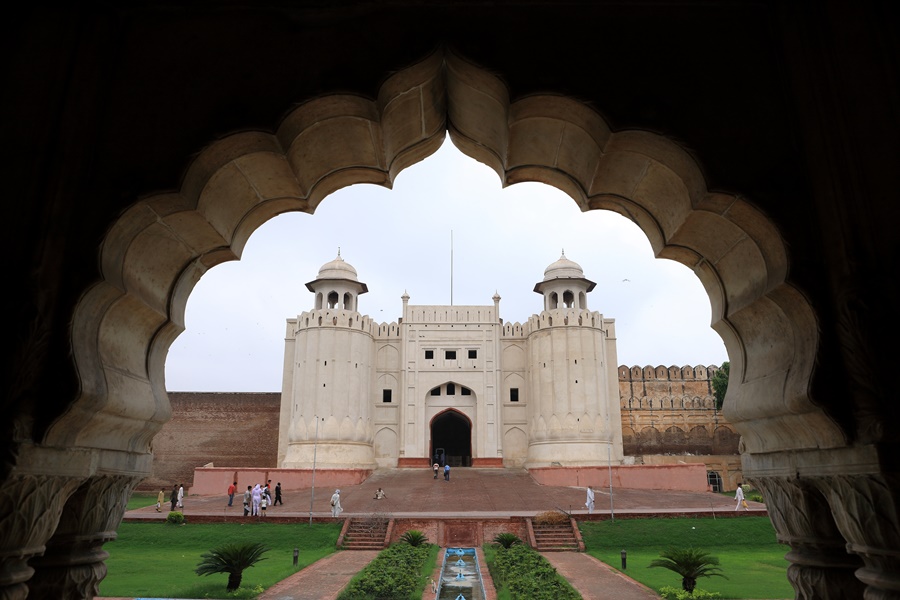
No Lahore travel experience is complete without visiting Lahore Fort, or Shahi Qila.
Standing at the heart of the historic city, the fort represents centuries of architectural development, with major additions and transformations taking place during the Mughal period. The complex contains palaces, courtyards, mosques, gardens and pavilions that reflect the artistic ambitions of successive Mughal emperors.
Among its most famous features are the Alamgiri Gate, Sheesh Mahal and Naulakha Pavilion.
The fort is particularly remarkable because it brings together different architectural and artistic influences, including Persian, Islamic and South Asian traditions.
The Alamgiri Gate faces the Badshahi Mosque, creating one of the most iconic architectural compositions in Lahore.
The fort later experienced another chapter under Sikh rule, when parts of the complex were adapted for new purposes.
A visit to Lahore Fort is therefore more than an encounter with Mughal architecture. It is a journey through the changing political and cultural history of Lahore.
Lahore Fort forms part of the UNESCO World Heritage property that also includes Shalimar Gardens.
Immediately beside Lahore Fort stands Badshahi Mosque, one of the city’s most recognizable landmarks.
Commissioned by Mughal Emperor Aurangzeb and completed in 1673, the mosque is an extraordinary expression of Mughal architecture. Its monumental red sandstone exterior, marble details, enormous courtyard, domes, and towering minarets create a sense of scale that is difficult to appreciate from photographs alone.
The mosque’s position opposite Lahore Fort makes the two monuments an essential pairing on any city tour.
Visitors should allow time to appreciate both the architecture and the atmosphere of the mosque complex. As an active place of worship, appropriate dress and respectful behavior are expected.
For international travelers, Badshahi Mosque offers an immediate sense of the grandeur that Lahore acquired during the Mughal era.
While Badshahi Mosque impresses through scale, Wazir Khan Mosque captivates through detail.
Located within the Walled City, the mosque was commissioned during the reign of Emperor Shah Jahan and is renowned for its elaborate tile work, frescoes, calligraphy, and colorful decorative surfaces.
Its architecture is closely connected with the traditional route through which the Mughal court approached Lahore Fort.
Walking toward the mosque through the old city makes the experience even more memorable. The surrounding streets retain the character of historic Lahore, with shops, markets, workshops, and everyday urban life continuing around the monument.
For travelers interested in Islamic art, architecture and traditional craftsmanship, Wazir Khan Mosque is one of Lahore’s essential experiences.
The Walled City of Lahore is where visitors can move beyond monumental architecture and experience the living city.
Its narrow lanes, historic gates, bazaars, mosques, havelis, workshops and food streets reveal a Lahore that cannot be captured from a sightseeing bus.
This is where architecture becomes part of everyday life.
The old city is best explored on foot, allowing time to notice details that are easily missed: carved wooden balconies, decorated façades, traditional shops, old signs, artisans at work and the changing rhythm of the streets.
For international visitors, a guided walking tour can add considerable depth because many of the city’s most interesting stories are connected to individual buildings, neighborhoods and families.
Delhi Gate is one of the historic entrances to the Walled City and provides an excellent starting point for exploring old Lahore.
From here, visitors can enter a network of narrow streets leading toward historic mosques, markets and traditional neighborhoods.
The experience is less about reaching a single attraction and more about allowing the old city to unfold around you.
Near Wazir Khan Mosque stands Shahi Hammam, a historic Mughal-era bathhouse.
Its rooms, domed ceilings, and traditional bathing arrangements provide insight into an important aspect of urban life during the Mughal period.
The hammam also forms part of the historic urban ensemble surrounding Wazir Khan Mosque and the old route toward Lahore Fort.
Together, these sites demonstrate that Mughal Lahore was not simply a city of imperial palaces. It was also a sophisticated urban environment with markets, baths, mosques, caravan facilities and residential neighborhoods.
One of the best ways to experience the Walled City is through food.
The historic Food Street area near the Lahore Fort has become one of the city’s best-known culinary destinations.
Restaurants and traditional food establishments serve Pakistani and Punjabi dishes while offering views toward the historic monuments.
In the evening, the area becomes particularly atmospheric, with the illuminated architecture of the old city providing a memorable backdrop to dinner.
For international travelers, Food Street is more than a restaurant district. It is an introduction to Lahore’s belief that food, hospitality and social life belong together.
Rising prominently near the Lahore Fort and Badshahi Mosque complex, Minar-e-Pakistan is one of the country’s most important national monuments.
The tower commemorates the Lahore Resolution of 1940, an important milestone in the political movement that eventually led to the creation of Pakistan.
Its location is historically significant, linking modern Pakistan with the historic heart of Lahore.
For visitors interested in the country’s political history, Minar-e-Pakistan provides an important connection between the city’s Mughal past and the creation of the modern state.
If Lahore Fort represents Mughal power and architecture, Shalimar Gardens reveal the Mughal fascination with nature, water and the idea of paradise.
Commissioned by Emperor Shah Jahan, the gardens were designed with terraces, channels, pools, fountains and carefully arranged plantings.
Their design reflects the influence of Persian and Central Asian garden traditions while adapting them to the landscape of Punjab.
The gardens are part of the same UNESCO World Heritage property as Lahore Fort. UNESCO describes the two complexes as outstanding examples of Mughal artistic expression at its height.
A visit to Shalimar Gardens provides a quieter experience than the Walled City and offers an opportunity to appreciate the aesthetic philosophy behind Mughal garden design.
On the outskirts of Lahore stands the Tomb of Emperor Jahangir, one of the city’s most elegant Mughal monuments.
Built for the Mughal emperor who ruled from 1605 to 1627, the tomb is surrounded by formal gardens and decorated with marble and sandstone details.
Its symmetrical layout and decorative craftsmanship demonstrate the importance of garden tombs in Mughal architecture.
The site is particularly attractive to travelers interested in architecture, photography and the history of the Mughal dynasty.
Near Jahangir’s Tomb is Akbari Sarai, a large historic caravanserai.
Caravanserais were essential components of the travel and trade networks of the Mughal world. They provided accommodation for travelers, traders, pilgrims, and their animals.
The large enclosed courtyard and surrounding chambers provide an insight into how people traveled across the subcontinent centuries ago.
Together, Akbari Sarai and Jahangir’s Tomb reveal the wider landscape of Mughal Lahore beyond the imperial center.
Chau Burji, meaning “Four Towers,” is another historic Lahore landmark.
The surviving structure is associated with the Mughal period and is distinguished by its four corner towers, decorative details and red-brick construction.
It once formed part of a larger garden complex and today stands amid the rapidly developing city.
For travelers interested in lesser-known heritage sites, Chau Burji provides an interesting contrast to the monumental Lahore Fort and Badshahi Mosque.
The Lahore Museum is one of the country’s most important museums and a valuable stop for anyone wanting to understand the historical context of Lahore.
Its collections cover archaeology, art, religion and the cultural history of the region.
Among its most important holdings are Gandhara sculptures and artifacts, along with Islamic art, manuscripts and other historical objects.
The museum is particularly useful before visiting other archaeological and historical destinations in Pakistan because it introduces visitors to the wider cultural landscape of Punjab and the ancient civilizations that developed across the region.
For international travelers, a visit here can transform the monuments seen elsewhere in Lahore from beautiful buildings into parts of a much larger historical story.
Lahore’s history did not end with the Mughal Empire.
The city became an important center of the Sikh Empire under Maharaja Ranjit Singh, whose reign left a lasting architectural and cultural imprint.
This heritage can be explored through Sikh religious and historical sites across the old city.
The Sikh heritage of Lahore is particularly important for visitors interested in religious history and the shared cultural landscape of Punjab.
The city and surrounding region contain important gurdwaras and sites associated with Sikh history.
Exploring this heritage alongside the Mughal monuments demonstrates how Lahore changed as political power shifted while remaining a major cultural center.
Near Lahore Fort and Badshahi Mosque stands the Samadhi of Maharaja Ranjit Singh.
Its location is particularly significant because it places Sikh heritage directly within the historic Mughal heart of the city.
The proximity of Mughal, Sikh, and Islamic monuments illustrates the extraordinary historical layering of Lahore.
The British period introduced another architectural and cultural layer to the city.
Lahore became an important administrative, educational and institutional center during British rule, and many of its most distinctive colonial buildings date from this period.
The historic Lahore Railway Station is an impressive example of nineteenth-century colonial architecture.
Its imposing façade, towers, arches and interior spaces reflect the importance of the railway in connecting Lahore with other parts of British India.
The station remains an active transportation hub, making it a particularly interesting example of heritage that continues to serve a practical purpose.
The Lahore High Court is another important architectural landmark associated with the colonial era.
Its imposing design reflects the institutional architecture of British India and forms part of the historic architectural landscape of central Lahore.
The historic General Post Office is another notable colonial-era landmark.
Its architecture reflects the mixture of European and local influences that became characteristic of Lahore during the British period.
Together, the railway station, High Court, GPO and other colonial buildings provide a useful counterpoint to the Mughal architecture of the old city.
Despite its reputation for bustling streets and busy markets, Lahore is also a city of gardens.
The traditional Mughal garden heritage continues in modern parks and landscaped spaces.
Formerly known as Lawrence Gardens, Bagh-e-Jinnah is one of Lahore’s best-known green spaces.
Its mature trees, lawns, walking paths and historic setting provide a peaceful escape from the city.
For travelers interested in Lahore’s colonial history and urban development, the park also provides an example of how landscaped public spaces evolved during the British period.
Jilani Park is another popular green space, offering lawns, gardens, and recreational areas.
It can be a pleasant addition to an itinerary for visitors who want to slow down between heritage visits.
Lahore is famous for food, and the reputation is well deserved.
The city’s cuisine reflects the traditions of Punjab as well as the broader culinary influences that have shaped Lahore over centuries.
Eating in Lahore should therefore be treated as a cultural experience rather than simply a practical necessity.
A day of sightseeing can begin with a traditional breakfast, continue with kebabs or a Punjabi meal, and end with dinner in the Walled City.
Nihari is one of the dishes visitors should try while exploring Lahore.
The slow-cooked meat stew is rich, aromatic, and deeply flavored, usually served with naan.
Although enjoyed throughout Pakistan, eating traditional nihari in Lahore provides an opportunity to experience the city’s long-established food culture.
Paya is another traditional dish based on slow cooking.
Prepared from trotters and a rich, spiced broth, it is valued for its depth of flavor and texture.
It represents a style of cooking in which patience and careful preparation transform simple ingredients into a deeply satisfying meal.
Lahori chargha is a whole chicken marinated with spices and then steamed or otherwise prepared before being fried or roasted.
The result is crisp on the outside and tender inside.
For visitors wanting to sample Lahore’s famous meat dishes, chargha is a worthwhile choice.
Lahore is also renowned for grilled meat.
Chicken tikka, seekh kebabs, and other barbecue dishes are widely available throughout the city.
The smoky aroma of charcoal grills is part of the sensory experience of Lahore’s food streets and traditional restaurants.
During the cooler months, Lahore’s famous fried fish becomes particularly popular.
Fish is seasoned, coated, and fried before being served with chutneys and other accompaniments.
It is especially associated with winter evenings and Lahore’s traditional food culture.
Haleem, made from grains, lentils, meat and spices, offers another example of the richness of Pakistani cuisine.
Biryani is also widely available and provides visitors with a fragrant rice-based meal combining meat, spices, and aromatic rice.
Although neither dish is exclusive to Lahore, both have become an important part of the city’s diverse food scene.
Bread is central to Punjabi cuisine.
Fresh naan cooked in a tandoor is the natural companion to nihari, kebabs, karahi and other traditional dishes.
Visitors should try bread directly from a traditional tandoor whenever possible. The combination of crisp edges, soft interior, and smoky aroma is difficult to reproduce elsewhere.
Lahore’s food experience should finish with something sweet.
Visitors can try traditional desserts such as jalebi, gulab jamun, kheer, and a variety of milk- and flour-based sweets.
Traditional sweet shops throughout the city provide an easy opportunity to sample several varieties.
Lahore’s markets are part of its cultural identity.
The Walled City contains traditional bazaars where visitors can find textiles, embroidery, handicrafts, jewelry, traditional clothing, footwear, and other local products.
Shopping here is less about finding a particular store and more about experiencing the commercial traditions of the old city.
The narrow streets, historic buildings, and colorful displays create an atmosphere that is very different from modern shopping malls.
For international travelers, traditional bazaars are also an opportunity to meet local artisans and discover the craftsmanship associated with Punjab.
Lahore’s importance extends beyond architecture and food.
The city has long been associated with poetry, literature, music, painting, theatre and the performing arts.
Its universities, galleries, cultural institutions and literary traditions continue to attract artists, writers and intellectuals.
For travelers interested in contemporary Pakistan, this cultural dimension is important.
Lahore demonstrates that Pakistani culture is not simply preserved in museums and monuments. It continues to evolve through music, literature, food, fashion, and the arts.
One of the most popular excursions from Lahore is to the Wagah Border, where visitors can witness the daily flag-lowering ceremony.
The ceremony features highly choreographed drills, patriotic displays, and the lowering of the flags on both sides of the international border.
For visitors, the experience is unusual because it combines military ceremony, national identity, public participation and the complicated history of the relationship between Pakistan and India.
The ceremony can attract large crowds, particularly during holidays and peak travel periods, so it is advisable to plan the visit accordingly.
A visit to Wagah provides an opportunity to experience an aspect of modern South Asian history that is very different from Lahore’s Mughal monuments.
Lahore is also an excellent base for exploring Punjab.
The province contains some of Pakistan’s most important archaeological, cultural, and historical destinations.
For travelers interested in ancient history, Harappa is one of the most important excursions from Lahore.
The archaeological site was one of the major urban centers of the Indus Valley Civilization, which flourished thousands of years ago.
The ruins and museum provide an opportunity to learn about an ancient urban society that developed sophisticated systems of planning, craftsmanship, and trade.
Harappa can be incorporated into longer journeys toward southern Punjab and is particularly valuable for travelers who want to place Lahore’s later Islamic and Mughal history within the much deeper story of South Asian civilization.
The area around Sheikhupura provides another opportunity to explore Mughal-era heritage.
Hiran Minar, associated with the reign of Emperor Jahangir, is a distinctive Mughal-era complex combining a tall minaret-like structure with a large water tank and surrounding landscape.
It offers an interesting contrast to Lahore’s monumental Mughal architecture and can be included in a broader excursion from Lahore.
For travelers with additional time, the Salt Range offers a completely different landscape from Lahore.
The region is known for dramatic geological formations and the famous Khewra Salt Mine.
A journey toward the Salt Range can be combined with other historical and natural attractions in northern Punjab.
Lahore’s location makes it particularly valuable as part of a wider Pakistan itinerary.
From Lahore, travelers can continue south toward:
They can also travel northeast toward Islamabad and Taxila or continue toward the mountain regions of northern Pakistan.
This makes Lahore an important cultural link between Pakistan’s north and south.
A longer journey might therefore connect:
Karachi → Lahore → Islamabad → Hunza → Skardu
or:
Islamabad → Lahore → Harappa → Multan → Bahawalpur → Cholistan
Such itineraries reveal the remarkable diversity of Pakistan, from ancient archaeological civilizations to Mughal imperial cities, Sufi heritage, deserts and high mountains.
Lahore and Islamabad provide an excellent contrast for international visitors.
Islamabad is a young, planned capital surrounded by the Margalla Hills. Its identity is associated with greenery, modern architecture, government institutions, and mountain landscapes.
Lahore is older, denser, and more historically layered. Its identity is shaped by centuries of imperial rule, cultural exchange, architecture, markets, food and urban traditions.
Experiencing both cities allows travelers to see two very different sides of contemporary Pakistan.
A one-day Lahore city tour can cover the principal Mughal landmarks, including Lahore Fort, Badshahi Mosque, Minar-e-Pakistan, Wazir Khan Mosque, and part of the Walled City.
However, two full days are much better for experiencing Lahore properly.
With two days, travelers can divide their time between the historic center and the wider city.
One day can focus on:
Lahore Fort → Badshahi Mosque → Minar-e-Pakistan → Walled City → Wazir Khan Mosque → Food Street
A second day can include:
Shalimar Gardens → Lahore Museum → colonial heritage → Jahangir’s Tomb → shopping → Wagah Border
Travelers with three or more days can add excursions to Harappa, Sheikhupura, or other destinations in Punjab.
Lahore experiences hot summers, a monsoon period, and cooler winters.
Winter is generally the most comfortable season for extensive sightseeing.
Cooler temperatures make walking tours, heritage visits, markets, and food exploration much more enjoyable.
Winter is also the season when Lahori street food takes on a particularly lively character.
Spring brings pleasant weather and greenery to the city.
The gardens and parks are especially attractive, while outdoor sightseeing remains comfortable before the summer heat intensifies.
Summer can be extremely hot.
Visitors traveling during this period should plan outdoor sightseeing for mornings and late afternoons and use museums, shopping centers and indoor attractions during the hottest part of the day.
The monsoon season brings periods of rainfall and can temporarily transform the atmosphere of the city.
Rain can also affect traffic and outdoor sightseeing, so flexible planning is advisable.
For cultural travelers, Lahore can form the centerpiece of a Pakistan itinerary.
A heritage-focused route could follow:
Lahore Fort → Badshahi Mosque → Walled City → Wazir Khan Mosque → Shahi Hammam → Sikh Heritage → Lahore Museum → Shalimar Gardens → Jahangir’s Tomb
This journey introduces visitors to several centuries of history:
Few destinations in Pakistan provide such a concentrated historical experience.
For food travelers, Lahore can be approached almost as a culinary destination in its own right.
A typical day might begin with traditional breakfast, continue with a Punjabi lunch, include street-food tasting in the old city, and finish with dinner at Food Street or another traditional restaurant.
The city’s culinary identity is particularly strong because food is deeply embedded in social life.
Lahore is a place where meals are often long, shared, and conversational.
For international visitors, this hospitality can become as memorable as the monuments themselves.
Lahore offers extraordinary opportunities for photography.
The city combines:
The Walled City is particularly rewarding for documentary and street photography because every street contains layers of architectural and human detail.
The golden light around Lahore Fort and Badshahi Mosque near sunset can also create some of the city’s most memorable images.
Lahore changes significantly through the year.
Spring brings greenery, flowers, and relatively pleasant temperatures, making it one of the most attractive periods for gardens and outdoor sightseeing.
Summer is hot and can be humid, requiring careful planning for outdoor activities.
Autumn brings gradually improving temperatures and can provide comfortable conditions for sightseeing.
Winter is often the most pleasant season for exploring Lahore, particularly for walking tours, historic sites, markets, and food experiences.
Lahore is not simply a city of monuments.
Its true attraction is the relationship between the monuments and the life surrounding them.
The Lahore Fort tells the story of imperial power. Badshahi Mosque represents the grandeur of Mughal Lahore. Wazir Khan Mosque reveals the extraordinary decorative artistry of the period. Shalimar Gardens demonstrate the Mughal vision of paradise.
But step outside these monuments and another Lahore appears.
The narrow lanes of the Walled City remain full of shops and people. Traditional food continues to define social life. Sikh and colonial heritage remain visible throughout the city. Museums preserve the deeper history of Punjab. Parks provide moments of calm. And modern Lahore continues to evolve as a center of education, business, arts, and culture.
This combination makes Lahore one of Pakistan’s most compelling destinations.
A journey through Lahore is ultimately a journey through the story of Pakistan and South Asia.
Begin with the grandeur of the Mughal Empire at Lahore Fort and Badshahi Mosque. Walk through the Walled City and discover the intricate Wazir Khan Mosque, traditional bazaars, and historic streets. Explore the city’s Sikh and colonial heritage. Visit the Lahore Museum to understand the civilizations and cultures that shaped the region.
Then slow down.
Sit down for a plate of nihari or Lahori chargha. Tear into fresh naan from a tandoor. Try kebabs, haleem, biryani, traditional sweets, and the countless other flavors that have made Lahore famous throughout Pakistan.
Watch the city come alive in the evening. Explore Food Street. Experience the energy of its markets. Or travel to Wagah Border and witness one of the most unusual public ceremonies in South Asia.
And when you are ready to continue, Lahore opens the door to the wider Punjab—toward Harappa and the Indus Valley Civilization, Multan and its Sufi heritage, Bahawalpur and the Cholistan Desert, or northward toward Islamabad and the mountains.
Lahore is a city to explore slowly. Come for the Mughal architecture, stay for the food, walk through its historic streets, and discover a city where centuries of history remain part of everyday life.