Islamabad is unlike most capital cities in South Asia. Set against the forested Margalla Hills and spread across the historic Potohar Plateau, Pakistan’s capital combines modern urban planning with natural beauty, cultural heritage and easy access to some of the country’s most remarkable historical and mountain destinations.
The city was purpose-built in the 1960s to become Pakistan’s new capital, replacing Karachi. Its carefully planned sectors, broad tree-lined avenues, landscaped parks, green belts and spacious residential areas give Islamabad a distinctly open and peaceful character. Yet beyond its modern architecture lies a much older landscape. The Potohar Plateau has been a crossroads of civilizations, cultures and trade routes for thousands of years, while the hills around the city preserve historic settlements, caves and ancient pathways.
For visitors arriving in Pakistan for the first time, Islamabad provides an unusually gentle introduction to the country. Within a relatively compact area, you can admire the striking architecture of Faisal Mosque, learn about Pakistan’s history and cultural diversity in its museums, hike through the Margalla Hills, explore the old settlement of Saidpur, enjoy panoramic views from Daman-e-Koh, and experience traditional Pakistani food.
The capital is equally valuable as a starting point for exploring beyond the city. Ancient Taxila, the hill station of Murree, the valleys of Azad Kashmir, the Buddhist ruins of Takht-e-Bahi, the historic Rohtas Fort and the old city of Peshawar are all accessible from Islamabad by road. More importantly, the city is the principal gateway for journeys north toward Swat, Chitral, Gilgit, Hunza, Skardu, Astore, Fairy Meadows and other spectacular destinations of northern Pakistan.
This combination of city, culture, history, nature, cuisine and connectivity is what makes Islamabad more than a stopover. It is a destination in its own right—and an ideal place from which to begin discovering Pakistan.
The best way to experience Islamabad is to allow yourself time to move beyond its famous landmarks. The city rewards visitors who combine sightseeing with walks, viewpoints, museums, local food, and excursions into the surrounding hills.
A first visit can begin with the architectural landmarks that define the capital, followed by its museums and cultural attractions, and then continue into the Margalla Hills and older settlements surrounding the city.
No visit to Islamabad is complete without seeing Faisal Mosque.
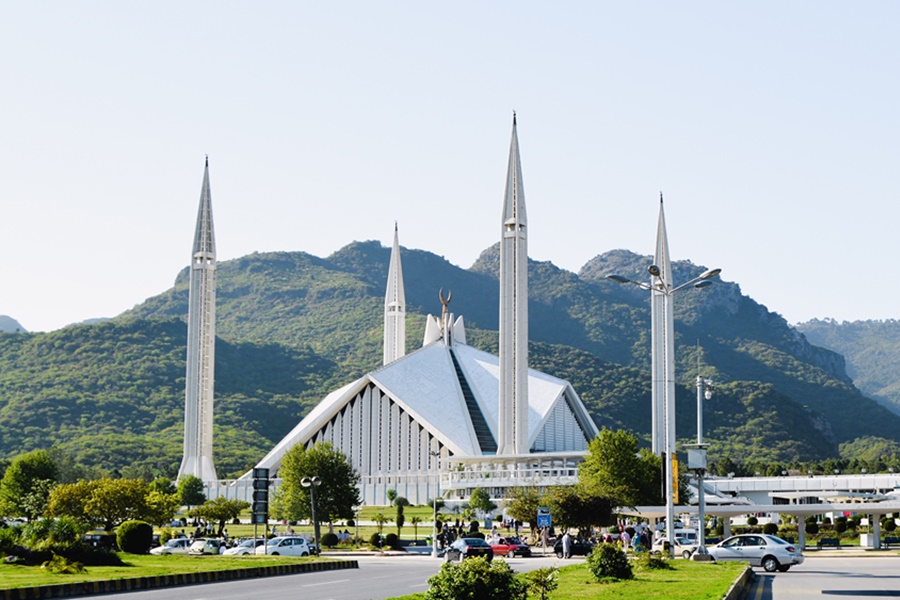
Standing dramatically at the foot of the Margalla Hills, the mosque is one of Pakistan’s most recognizable landmarks. Designed by Turkish architect Vedat Dalokay, its contemporary interpretation of Islamic architecture is immediately distinctive. The enormous tent-like prayer hall and four slender minarets create a striking silhouette against the mountains.
The setting is as important as the architecture. From the mosque complex, visitors can appreciate the scale of the Margalla Hills rising behind the city, while the spacious surroundings provide a sense of calm despite the mosque’s importance as one of the capital’s major landmarks.
For international visitors, Faisal Mosque provides an early introduction to Pakistan’s Islamic heritage and contemporary national identity. As it remains an active place of worship, visitors should dress modestly and observe appropriate behavior.
High on the Shakarparian Hills, the Pakistan Monument is another essential stop on an Islamabad sightseeing tour.
Designed in the form of a blossoming flower, the monument represents national unity, with its petals symbolizing Pakistan’s provinces and territories. Its elevated location also provides attractive views across the capital.
The adjoining Pakistan Monument Museum adds historical context, introducing visitors to important personalities, events, and stages in the development of Pakistan.
A visit here is particularly worthwhile for travelers who want to understand the country beyond its landscapes. The monument connects the modern capital with the historical story of the nation and provides useful context for exploring other parts of Pakistan.
One of the most rewarding cultural experiences in Islamabad is a visit to Lok Virsa Museum.
Pakistan is a country of extraordinary cultural diversity. Mountain communities in Gilgit-Baltistan and Khyber Pakhtunkhwa have traditions very different from those of Punjab, Sindh and Balochistan. These differences are reflected in clothing, crafts, music, embroidery, jewelry, woodwork, textiles and folk art.
Lok Virsa brings many of these traditions together. Its collections introduce visitors to the cultural heritage of different regions through traditional crafts, musical instruments, textiles, decorative objects, artwork and other cultural artifacts.
For travelers planning to explore Pakistan beyond Islamabad, the museum is especially valuable because it provides a cultural framework for understanding the people, traditions, and artistic heritage they will encounter elsewhere in the country.
Islamabad is also a useful starting point for understanding Pakistan’s much deeper history.
The Islamabad Museum presents collections representing different periods of the country’s archaeological and cultural heritage, including Stone Age material, discoveries associated with Mehrgarh, Indus Valley Civilization artifacts, Gandhara art, Islamic-period ceramics, Mughal miniature paintings, manuscripts and traditional cultural objects.
The museum helps place Pakistan within the much larger story of South Asian civilization. It introduces visitors to ancient settlements, the Indus Valley Civilization, Gandhara’s Buddhist heritage and later Islamic and Mughal cultural influences.
This background becomes particularly meaningful when visiting destinations such as Taxila, Peshawar and Lahore later in a Pakistan journey.
One of Islamabad’s greatest advantages is that you do not need to travel far to reach the mountains.
The Margalla Hills rise immediately north of the city and form its natural backdrop. Protected within Margalla Hills National Park, the hills offer hiking trails, forested landscapes, birdwatching, wildlife observation, photography, and scenic viewpoints.
Popular hiking routes include Trails 3, 5 and 6, along with shorter recreational trails. Even visitors who do not want a demanding hike can experience the landscape through a short walk or scenic drive.
The Margalla Hills demonstrate one of Islamabad’s defining characteristics: nature is not separated from the city. Forests, hills, and trails remain an integral part of the urban experience.
For one of the best panoramic views of the capital, head into the Margalla Hills to Daman-e-Koh.
The viewpoint overlooks Islamabad’s carefully planned sectors, broad avenues, green spaces, and surrounding landscape. On clear days, Faisal Mosque can be seen standing prominently against the mountains.
Daman-e-Koh is particularly attractive in the late afternoon and around sunset, when the changing light creates a different perspective of the city.
Higher in the Margalla Hills, Pir Sohawa offers another opportunity to enjoy Islamabad from above.
The drive itself is part of the experience, winding through the hills before opening onto expansive views of the capital. The cooler atmosphere and elevated setting make Pir Sohawa a popular escape from the city, particularly in the evening.
For visitors who want to combine sightseeing with a scenic mountain drive, Daman-e-Koh and Pir Sohawa can easily form part of the same outing.
Islamabad may be a young capital, but the land around it has a much older history.
Saidpur Village, situated at the foot of the Margalla Hills, provides an interesting contrast to the modern sectors of the city. Its historic character, religious and architectural elements, restaurants, cafés and cultural spaces offer visitors a glimpse of an older settlement landscape.
The contrast is particularly striking. A short drive can take you from Islamabad’s broad modern avenues into an older village environment surrounded by hills.
For many visitors, this contrast captures something important about Pakistan itself: modernity and tradition often exist side by side.
Shah Allah Ditta provides another glimpse into the ancient history of the Islamabad region.
Located near the Margalla Hills, the area contains caves and historic remains associated with ancient routes through the Potohar region. Its setting and archaeological character make it an interesting addition to a heritage-focused Islamabad itinerary.
It can also be combined with other historical attractions in the northern part of the capital for visitors who want to explore Islamabad beyond its better-known landmarks.
History enthusiasts can continue their journey into Pakistan’s railway heritage at the historic Golra Sharif Railway Station.
The Pakistan Railway Heritage Museum preserves locomotives, railway carriages, equipment, photographs, documents, and other memorabilia associated with the development of railways in the region.
The historic station itself adds to the experience. For photographers, families, railway enthusiasts, and travelers interested in colonial-era history, it offers a different perspective on the development of transportation and connectivity across the region.
Islamabad’s appeal is not limited to monuments and museums.
Rawal Lake and Lake View Park provide an opportunity to slow down and enjoy the outdoors. The lake, surrounding greenery, and recreational facilities make the area suitable for boating, photography, family activities, and relaxation.
Fatima Jinnah Park, commonly known as F-9 Park, represents another important aspect of the city’s original planning philosophy. Its expansive green spaces, walking areas, and recreational facilities demonstrate the emphasis placed on maintaining open areas within the capital.
The Rose and Jasmine Garden provides yet another peaceful setting, particularly when its flowers are in bloom.
Together, these spaces explain why Islamabad is often associated with greenery and open landscapes rather than the congestion normally associated with large capital cities.
One of Islamabad’s greatest advantages is its location. Within a few hours of the capital, travelers can move from modern Pakistan into archaeological sites, mountain valleys, historic cities, and Mughal-era heritage.
For visitors staying two or more nights in Islamabad, a day excursion can add an entirely different dimension to the trip.
Taxila is arguably the most important historical excursion from Islamabad.
Located within convenient driving distance of the capital, Taxila was a major center of learning, trade, and Buddhist culture in the ancient Gandhara region. Its archaeological remains include ancient settlements, monasteries, sculptures and other evidence of civilizations that flourished more than two thousand years ago.
For visitors interested in archaeology, Buddhism and ancient history, Taxila is an essential experience.
The combination of Islamabad and Taxila is particularly rewarding: within the same itinerary, travelers encounter a carefully planned modern capital and the remains of one of the ancient world’s important centers of culture and learning.
Murree is one of the easiest mountain escapes from Islamabad.
Set among the Himalayan foothills, the hill station is known for pine forests, mountain views, and a cooler climate. Visitors can explore Mall Road, Pindi Point, Kashmir Point and Patriata, where chairlift and cable-car facilities provide opportunities to experience the surrounding landscape.
Murree is particularly suitable for travelers looking for a relaxed mountain excursion rather than a demanding adventure. It also offers a useful introduction to Pakistan’s hill-station culture.
For travelers wanting to experience the mountains of Kashmir, Muzaffarabad makes an ambitious but rewarding day excursion from Islamabad.
Situated at the confluence of the Jhelum and Neelum Rivers, the capital of Azad Jammu and Kashmir is surrounded by rugged mountains and serves as a gateway to the Neelum and Jhelum valleys.
The city and its surroundings offer opportunities to see the Red Fort, rivers, mountain viewpoints, and local markets, while Pir Chinasi provides an elevated perspective over the surrounding landscape.
The journey from Islamabad to Muzaffarabad also introduces travelers to a very different environment from the planned capital.
Takht-e-Bahi is one of the most important Buddhist archaeological sites in Pakistan.
The ancient monastic complex in Khyber Pakhtunkhwa dates from the early centuries of the Common Era and remains one of the best-preserved Buddhist monastic sites associated with Gandhara.
Its ruins include monastic structures, meditation cells, courtyards, stupas, and other architectural remains.
For travelers interested in Buddhism, archaeology and ancient civilizations, Takht-e-Bahi provides an opportunity to explore a fascinating chapter of Pakistan’s history.
The Wah Mughal Gardens and Khanpur Dam offer a combination of history, landscape and recreation.
The Mughal gardens reflect the region’s historical association with the Mughal period, while nearby Khanpur Dam provides a scenic setting of blue water surrounded by hills.
Depending on the season and activities available, visitors can combine garden exploration with boating, photography, and outdoor recreation.
It is an excellent choice for travelers who want a less demanding day away from the capital.
Rohtas Fort is one of the most impressive historical excursions from Islamabad.
Built in the 16th century by Sher Shah Suri, the massive fort was constructed to control the strategically important route between northern India and the Afghan territories. Its enormous walls, bastions and gateways reflect the sophistication of medieval military architecture.
Visitors can explore the fort’s imposing defensive structures, including the Shahi Mosque, Rani Mahal and historic gateways such as Kabuli Gate and Sohail Gate.
Its architectural and historical importance has earned Rohtas Fort recognition as a UNESCO World Heritage Site.
For travelers interested in forts, medieval history, architecture, and photography, it is one of the most rewarding historical journeys available from Islamabad.
A journey toward Peshawar takes visitors into one of the most historically significant parts of Pakistan.
Peshawar is one of South Asia’s oldest cities and has long served as a crossroads between Central and South Asia. Its history is closely connected with trade routes, successive civilizations and the movement of people and armies across the region.
The city’s historic areas, Qissa Khwani Bazaar, Peshawar Museum, Mahabat Khan Mosque and traditional markets offer a glimpse into its distinctive cultural character.
The legendary Khyber Pass extends this experience into the dramatic landscape of the northwest. Historically linking the region with Afghanistan, the pass became one of the most important corridors for traders, travelers and invading armies moving between Central and South Asia.
For travelers interested in history, ancient trade routes, Gandhara heritage, and Pashtun culture, Peshawar and the Khyber Pass provide one of the most memorable excursions from Islamabad.
No travel experience in Pakistan is complete without food.
Cuisine is one of the best ways to understand the country because Pakistani food reflects the country’s regional diversity, history, and hospitality. Islamabad, as a national capital, brings together culinary traditions from across Pakistan, making it an excellent place for visitors to begin exploring Pakistani cuisine.
The food ranges from smoky barbecue and rich meat curries to fragrant rice dishes, breads, lentils, slow-cooked stews, refreshing drinks and traditional sweets.
For many international visitors, Pakistani barbecue provides one of the most accessible introductions to local food.
Seekh kebabs, made from seasoned minced meat and cooked over a grill, are particularly popular. Chicken tikka offers another classic experience, with pieces of marinated chicken cooked over charcoal or high heat.
Barbecue is often served with naan or other tandoori breads, chutneys, salad, and yogurt-based accompaniments.
The combination of smoke, spices, and charcoal cooking gives Pakistani barbecue a distinctive character.
Biryani is among Pakistan’s best-known rice dishes.
Fragrant rice is layered or cooked with meat, spices, and other ingredients to create a dish that is aromatic, rich, and deeply satisfying. Different regions and households prepare biryani differently, so trying it in Pakistan is part of discovering the diversity of the cuisine.
For visitors unfamiliar with Pakistani food, biryani is an excellent introduction to the country’s use of spices and aromatic rice.
Nihari is a rich, slow-cooked meat stew traditionally associated with breakfast and long, leisurely meals.
The meat is cooked for several hours with spices until tender, producing a deeply flavored gravy. It is commonly eaten with naan or other traditional breads.
Nihari is particularly representative of the rich culinary traditions that developed in the cities and communities of the Indo-Muslim cultural region.
Haleem combines grains, lentils, meat, and spices into a thick, slow-cooked dish.
Its texture and richness make it very different from grilled dishes such as kebabs, while its preparation reflects the patience often associated with traditional South Asian cooking.
It is commonly garnished with fried onions, herbs, lemon, and other accompaniments.
Paya is another traditional dish prepared through slow cooking.
Made using trotters and a richly spiced broth, the dish is valued for its deep flavor and texture. It represents the type of traditional cooking in which inexpensive cuts of meat are transformed through long cooking into intensely flavored dishes.
Karahi is one of the dishes visitors should seek out when exploring Pakistani cuisine.
Usually prepared with chicken or mutton, karahi is cooked in a rounded, wok-like vessel and typically features tomatoes, ginger, green chilies, and spices.
It is often served directly from the cooking vessel and shared at the table with naan or other breads.
For many Pakistanis, eating karahi is as much a social experience as it is a meal.
Chapli kebab provides visitors with a taste of the culinary traditions of Khyber Pakhtunkhwa.
The broad, flat kebab is made from seasoned minced meat and is known for its distinctive texture and bold flavors.
Trying chapli kebab in Islamabad is also a reminder of the capital’s position as a meeting point for culinary traditions from different parts of Pakistan.
Pakistani meals are rarely complete without bread.
Naan and other tandoori breads are cooked in traditional clay ovens and provide the perfect accompaniment to curries, kebabs, and stews.
Lassi, a yogurt-based drink, offers a refreshing contrast to spicy and richly flavored food. It can be enjoyed plain or sweetened, depending on the preparation.
Visitors should also leave room for dessert.
Pakistani sweets include a wide variety of milk-based, flour-based, and syrup-soaked preparations. Depending on where you eat, you may encounter dishes such as gulab jamun, jalebi, kheer, and other traditional sweets.
Food markets, bakeries, and restaurants across Islamabad provide opportunities to explore these flavors.
For international travelers, Pakistani cuisine should not be treated simply as something to eat between sightseeing stops.
Food offers a direct introduction to the country’s regional diversity.
A meal can reveal influences from Punjab, Sindh, Khyber Pakhtunkhwa, Balochistan, and the wider Indo-Muslim culinary tradition. It also provides an opportunity to experience one of the most important elements of Pakistani hospitality: sharing food with guests.
A well-planned Islamabad visit should therefore include time for both sightseeing and eating.
For many international visitors, Islamabad is not the final destination. It is the beginning of a much larger Pakistan journey.
The capital’s geographical position, transport connections, and concentration of hotels and services make it a natural base for exploring the country.
From Islamabad, travelers can begin road journeys toward the northern mountains, while flights can provide access to destinations such as Gilgit and Skardu depending on schedules and weather conditions.
Islamabad is the natural starting point for journeys toward some of Pakistan’s most spectacular mountain regions.
Travelers can continue north toward:
For travelers heading toward Hunza or Skardu, spending one or two nights in Islamabad before departure can be especially useful.
It allows visitors to recover from an international flight, adjust to the local environment, and begin their journey without immediately undertaking a long road journey.
The capital also provides an opportunity to experience Pakistani culture before entering the more remote mountain regions.
For journeys toward Gilgit-Baltistan, Islamabad serves as the principal starting point.
Travelers can choose between air travel, where scheduled flights are available and weather permits, and road journeys through the spectacular mountain landscapes of northern Pakistan.
The road journey itself can become part of the adventure, passing through changing landscapes as the plains gradually give way to valleys and high mountains.
Once in Gilgit-Baltistan, travelers can continue toward destinations such as Hunza, Nagar, Astore, and other valleys.
Skardu is another major destination accessed from Islamabad.
For international travelers, the flight to Skardu can save considerable travel time and provides an extraordinary introduction to the mountain landscape when weather and flight schedules permit.
Skardu then serves as a base for exploring Baltistan, including Shigar, Khaplu, Deosai, and other surrounding destinations.
For adventure travelers heading toward trekking routes and high mountain areas, Islamabad often becomes the logistical starting point before the journey moves deeper into the Karakoram.
The capital can work equally well at the beginning or end of an itinerary.
At the beginning of a trip, Islamabad provides a comfortable introduction to Pakistan before travelers move into the mountains, historic cities, or more remote regions.
At the end, it provides a convenient place to rest, shop, enjoy restaurants, and reflect on the journey before an international departure.
A traveler might therefore combine:
or create a wider journey connecting the capital with Lahore, Peshawar, Kashmir and the northern mountains.
The possibilities are extensive because Islamabad sits at the intersection of several major travel corridors.
Although Islamabad and Rawalpindi have effectively grown into one metropolitan area, they offer very different experiences.
Islamabad represents the modern, planned capital, characterized by broad avenues, diplomatic districts, parks, contemporary architecture, and spacious residential sectors.
Rawalpindi has a much older and more traditional urban character. Its historic bazaars, crowded streets, traditional markets, and older neighborhoods provide a closer look at everyday urban life in Pakistan.
For visitors with additional time, experiencing both cities offers a useful contrast between Pakistan’s modern national capital and a traditional South Asian city.
A single day can cover the major highlights, including Faisal Mosque, Pakistan Monument, Lok Virsa Museum, Daman-e-Koh and Saidpur Village.
However, two days provide a much better introduction to the capital.
With two days, visitors can slow down and include additional experiences such as the Margalla Hills, Rawal Lake, Shah Allah Ditta, Golra Sharif, or F-9 Park.
If you want to add a day excursion, each destination should generally be treated as a separate full-day experience. Taxila, Murree, Muzaffarabad, Rohtas Fort and Peshawar require sufficient time for the journey as well as sightseeing.
For international travelers arriving in Pakistan, spending at least one or two nights in Islamabad before continuing north is therefore a sensible approach.
Islamabad is best experienced not as a checklist of monuments, but as a city of contrasts.
Start with its most recognizable architecture at Faisal Mosque and Pakistan Monument. Continue into the museums to understand Pakistan’s history and cultural diversity. Move into the Margalla Hills for nature and panoramic views. Explore Saidpur and Shah Allah Ditta to discover the older landscape surrounding the modern capital.
Then go beyond the city.
Visit Taxila to step into the world of ancient Gandhara. Travel to Murree for a taste of Pakistan’s hill-station culture. Head toward Muzaffarabad for the mountains of Kashmir, Rohtas Fort for medieval history, Takht-e-Bahi for Buddhist heritage, or Peshawar and the Khyber Pass for an encounter with the historic northwest.
And between these experiences, make time for food.
Try kebabs, biryani, nihari, haleem, karahi, chapli kebab, tandoori breads, lassi, and traditional sweets. Pakistani cuisine is not simply an accompaniment to travel; it is one of the country’s most important cultural experiences.
Most importantly, use Islamabad as a gateway rather than merely a stopover.
From here, the landscape changes dramatically. Roads and flights lead toward the valleys of Swat and Chitral, the high mountains of Gilgit-Baltistan, the valleys of Hunza, and the spectacular landscapes around Skardu.
Islamabad offers visitors an unusual introduction to Pakistan.
It is a modern capital surrounded by mountains, but it also stands on a landscape with thousands of years of history. It has museums preserving the country’s cultural heritage, ancient archaeological sites nearby, traditional settlements alongside carefully planned urban sectors, and a food culture that brings together flavors from across the country.
Its greatest strength is this variety.
In a single journey, you can stand beneath the towering minarets of Faisal Mosque, look across the capital from Daman-e-Koh, walk through a forested mountain trail, discover traditional culture at Lok Virsa, explore the archaeological heritage of Taxila, share a Pakistani meal, and then begin a journey toward the high mountains of Hunza or Skardu.
For first-time visitors, Islamabad offers a comfortable and fascinating introduction to Pakistan.
For travelers exploring the country more extensively, it provides the ideal logistical and cultural starting point.
Come for the capital, discover the culture, taste the cuisine, explore the surrounding heritage, and then follow the road north into the mountains. Islamabad is where many Pakistan journeys begin—and where the many stories of the country start to come together.