


Overview
The Pagan Kalash & Chitral Tour offers an extraordinary journey into the cultural and natural diversity of northern Pakistan, linking the lush valleys of Swat with the remote mountain communities of Chitral and the distinctive heritage of the Kalash people. From the archaeological legacy of ancient Gandhara to centuries-old Kalash traditions and the dramatic landscapes of the Hindu Kush, the journey reveals a region where history, belief, nature, and community remain closely intertwined.
The journey begins in Swat Valley, renowned for its emerald-green landscapes, rushing rivers, alpine forests, and dramatic mountains. Beyond its scenic beauty, Swat holds an important place in the history of Gandhara Buddhism. Between the 1st century BCE and the 7th century CE, the valley developed into an important center of Buddhist learning and pilgrimage. Ancient stupas, monasteries, sculptures, and archaeological sites scattered across the region provide a glimpse into this remarkable period of cultural and religious exchange.
From Swat, the route continues towards Chitral, a historic mountain region surrounded by the towering peaks of the Hindu Kush. Chitral has long served as a meeting point between South Asia and Central Asia, reflected in its history, languages, architecture, and cultural traditions. In Chitral town, the Chitral Fort and Shahi Mosque recall the era of the Mehtar rulers, while the surrounding valleys provide spectacular views of rugged mountains and traditional settlements. The region is also associated with Tirich Mir, the highest peak of the Hindu Kush, whose imposing presence dominates the landscape.
The cultural heart of the journey lies in the Kalash Valleys of Bumburet and Rumbur, home to the Kalash people, an indigenous community whose distinctive culture has survived for centuries in the remote valleys of Chitral. The Kalash maintain their own language, traditional beliefs, festivals, music, dances, dress, architecture, and social customs, making their communities one of the most distinctive cultural landscapes in Pakistan.
Kalash culture is closely connected with nature, agriculture, seasonal cycles, community life, and ancestral traditions. Their traditional religious practices include reverence for natural forces and a pantheon of deities, while important festivals mark different stages of the agricultural and seasonal calendar. Festivals such as Joshi, Uchal, and Chaumos bring communities together through music, dancing, feasting, rituals, and traditional celebrations. Women are particularly recognizable for their distinctive black dresses, colorful embroidery, elaborate headdresses, and traditional ornaments.
A visit to the Kalash valleys provides an opportunity to experience this living culture within its natural setting. Traditional wooden houses, village pathways, grazing lands, mountain streams, and terraced fields form part of an environment in which cultural traditions remain closely connected to everyday life. The experience is best approached with respect for local customs and as an opportunity to learn from a community whose cultural identity has endured despite generations of change.
Beyond the Kalash valleys, the surrounding Chitral region offers a remarkable combination of mountain scenery, wildlife, traditional villages, and cultural heritage. Gol National Park, located near Chitral, provides an opportunity to explore the region’s high-altitude wilderness and, with appropriate conditions, observe its diverse wildlife. The wider landscape of valleys, forests, rivers, and snow-covered peaks provides a striking contrast to the more settled plains of Pakistan.
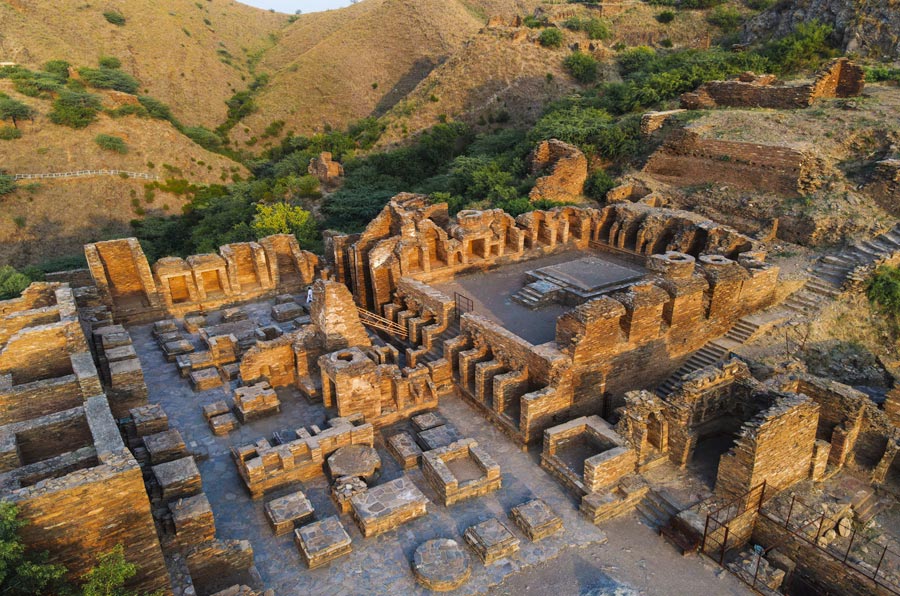
The return journey adds another important chapter to the region’s historical story with a visit to Takht-i-Bahi, one of the best-preserved Buddhist monastic complexes associated with ancient Gandhara. Once an important center of Buddhist learning and religious life, its hilltop ruins provide a tangible connection with the civilizations that flourished across this region more than a millennium ago.
The tour concludes in Peshawar, one of South Asia’s historic urban centers and an important city on the ancient routes connecting the Indian subcontinent with Central Asia. Its historic bazaars, architecture, and multicultural heritage offer a fitting conclusion to a journey tracing centuries of movement, exchange, belief, and cultural continuity.
The Pagan Kalash & Chitral Tour therefore brings together three distinctive dimensions of northern Pakistan: Gandhara’s archaeological heritage, the living cultural traditions of the Kalash people, and the spectacular mountain environment of Chitral and the Hindu Kush. It is a journey designed for travelers seeking meaningful cultural encounters alongside some of Pakistan’s most remarkable landscapes.
Highlights
- Scenic drive through Swat Valley with its lush landscapes and Gandhara heritage
- Cultural immersion with the Kalash people in Bamburet & Rambur valleys
- Breathtaking views across the Hindu Kush
- Exploration of historic Chitral and its royal landmarks
- Visit to Chitral Fort and Shahi Mosque
- Excursion to Gol National Park for panoramic mountain views
- UNESCO heritage visit to Takht-e-Bahi
- Cultural exploration of historic Peshawar


